Process

Before we begin patterning of a structure we must take various aspects into account: State of the program We have already mentioned that WinTess3 is a program ā€œall-in-oneā€ type suite with very clear three states of the program. In order to make aĀ pattern, it is necessary that the program is in the state ofĀ Patterning, so…

Menu: Patterns

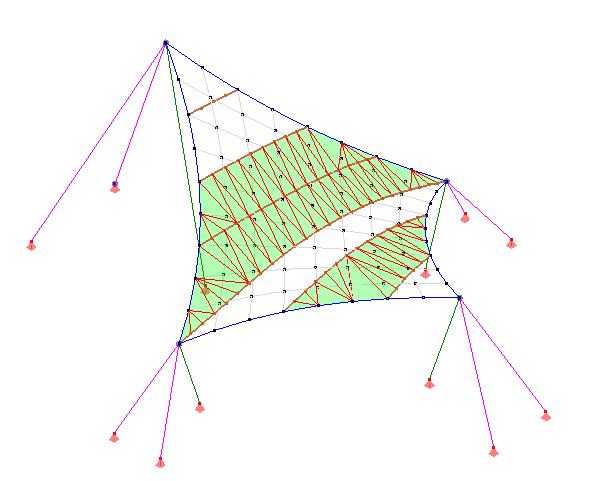
Having activated this menu, WinTess draws the existing patterns on screen. On the top line of the screen, we see a checkbox that enables us to draw the triangles that form the patterns to get a clearer idea of how they areĀ created. We can enable or disable this checkbox as we wish. Ā  Create a…

Patterning

Translating 3D Structure to 2D Membrane Fabric Rolls Membrane surfaces are almost never flat. In fact they should never be. These are warped surfaces. These surfaces can be classified into two groups: – Synclastic surfaces They have the same curvature at all points. That is the intersection of a plane perpendicular to said surface produces…

Pattern Types

Patterning is one of the basic tasks of designing tensile membrane structures. It is also one of three modules of WinTess software shown in top bar. The usual way to transform a warped curved surface in flat strips (patterns) is doing by triangulation. It is the easiest and most used way. In another post in…

Multi-geodesic Lines

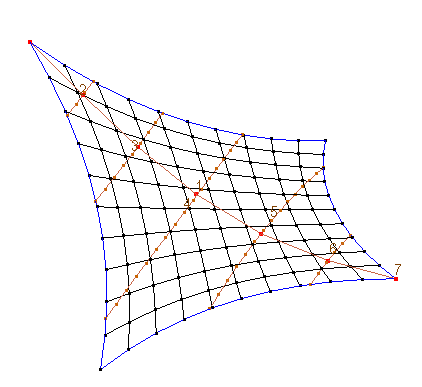
The most common method of creating patterns on a membrane involves drawing geodesic lines on the membrane. Justification of the layout of the geodesic lines is beyond the scope of this text. Although the geodesic lines can be drawn freely to form patterns of any shape and position, it is common that the route of…

Cross Compensation

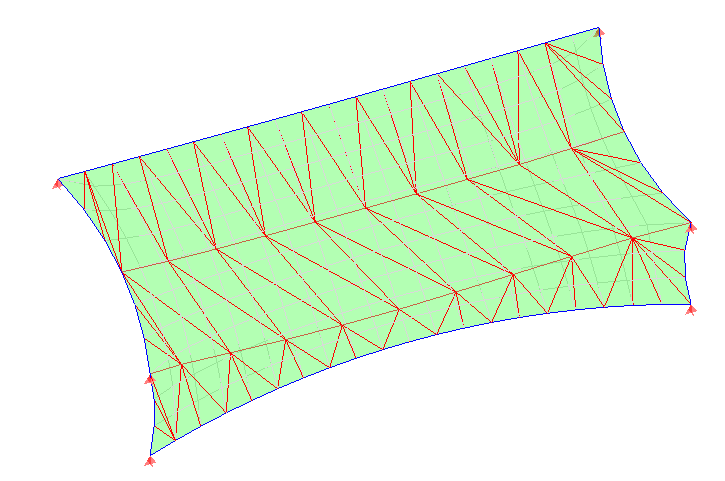
The common way of patterning of a tensile membrane is to break down to triangles which are always flat (see the below figure). This series of adjacent triangles is called as pattern. It is obvious that the triangles are defined by the sides, and these are straight segments while the membrane surface is curved (almost…

Modifying Patterns

Sometimes we find a membrane to which you have applied a certain design. Everything has been done successfully, but at some point we would slightly change the pattern. The reasons can be different: the pattern does not fit into the width of the fabric by a little while you have enough membrane to compensate on…